
Unlocking the Street Spectacle of Cotswold Morris
The first encounter can feel almost cinematic. Brass bells strike the air, a concertina gathers speed, and a line of white-clad dancers suddenly takes possession of a village square, green, or pub forecourt. Handkerchiefs flare like small flags, sticks crack together above shoulder height, and the dancers leap with an energy that makes the whole setting seem to tilt towards the performance. In Oxfordshire, this is not a museum display. It is a living event, often encountered at close quarters, with spectators standing only a few steps from the set.
For visitors exploring Headington Quarry Morris or seeking the celebrated dances of Bampton, the key is to move beyond the familiar stereotypes of Morris as quaint, baffling, or faintly comic. Cotswold Morris is street theatre, rhythmic exercise, local history, costume craft, and community ritual at once. Oxfordshire is one of its great heartlands, with old village traditions, revival sides, university dancers, and mixed groups keeping the repertoire in motion. Once the visual clues and musical patterns become legible, the spectacle becomes far more vivid.
Cracking the Kit Code Across Oxfordshire Parishes
The white shirt and trousers create the visual ground on which each side writes its identity. Across the costume, a baldrick, or crossed sash, may carry ribbons, badges, rosettes, and other details associated with a particular village or organisation. These are not merely decorative flourishes. They can commemorate dancers, mark anniversaries, refer to local occupations, or preserve the memory of an older kit. A close look often reveals years of communal history in miniature, particularly in the handmade decorations and carefully maintained accessories.
The bells below the knee are equally important. They are not fitted simply to provide a cheerful jingle. The dancer’s stepping, stamping, and leaping give them kinetic force, creating a second percussion line beneath the music. The effect is strongest when six dancers land together, turning movement into sound. Black shoes are common, although historical research shows that footwear was once an economic issue, since poorly paid labourers could struggle to replace worn dancing shoes. Hats are more variable and often carry their own stories, from inherited decorations to local styles such as cricket caps.
Costume differences are especially useful when several sides appear at the same event. The table below is a guide rather than a rigid rule. Morris kit changes over time, and individual dancers may wear personal variations, but these broad characteristics help newcomers read the scene.
| Side or tradition | Visual clues | What to notice |
|---|---|---|
| Bampton Morris | White clothing, bells, decorated baldricks, distinctive village regalia | A deep local repertoire, strong Whit Monday identity, and supporting characters linked to Bampton custom |
| Headington Quarry Morris | White kit with ribbons, badges, bells, sticks, and local associations | Connections to Quarry history, William Kimber, and a repertoire preserved through generations |
| Oxford University Morris | Contemporary mixed-gender Cotswold kit with side-specific ribbons and accessories | A university, alumni, and city-facing tradition that performs locally and on tour |
| Other Cotswold sides | White shirts and trousers or dark breeches, black shoes, bells, baldricks or waistcoats | Village-specific steps, colours, music, and variations in hats, flowers, ribbons, and props |
Deciphering the Dance Mechanics of Sticks and Hankies
Large white handkerchiefs make the movement readable from a distance, but their purpose goes well beyond visibility. A sharp wrist snap sends the cloth into a sudden arc, allowing spectators to see the exact moment a gesture begins and ends. During a leap, the hankies can appear to suspend the dancer in the air. They frame the arms, emphasise changes of direction, and make a compact sequence of steps feel expansive. Watch the wrists rather than only the feet, and the discipline behind the apparent exuberance becomes clear.
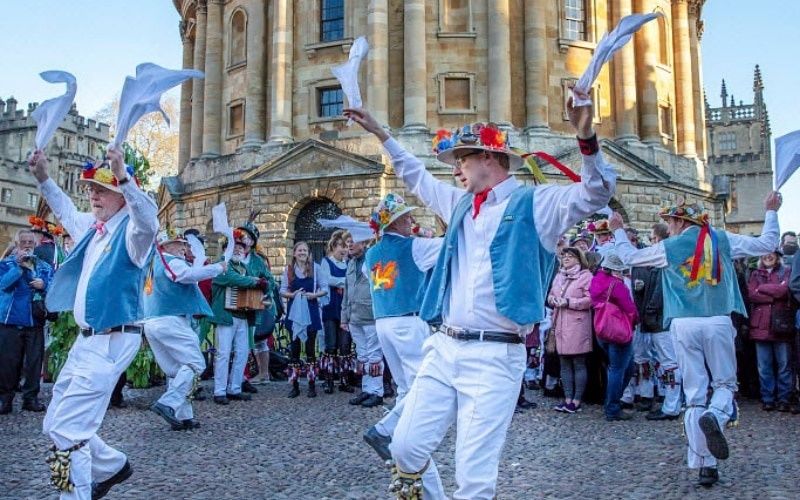
Stick dances add a percussion instrument to the choreography. The sticks are generally seasoned hazel or ash, prepared to withstand repeated impact, but the striking still demands accuracy and trust. Dancers must judge distance, raise the stick cleanly, meet the partner’s blow at the correct point, and recover without breaking the rhythm. The crack is exhilarating because it carries a small, controlled risk. It is not random roughness; it is a carefully rehearsed conversation in wood, timing, and space.
A conventional Cotswold set often begins with six dancers arranged in a recognisable formation, although dances may be adapted for fewer performers or presented as solo and paired jigs. A musician, commonly playing a fiddle, melodeon, or concertina, provides the pulse and responds to the dancers’ phrasing. The Fool may enter as an energetic disruptor, guide, comic commentator, or protector of the performance space. Other sides may include a Squire, who leads and manages the set, a Bagman handling practical arrangements, or characters carrying a cake or a bladder-and-tail staff. The Cotswold Morris tradition contains many such local variations, so the same basic grammar can produce remarkably different theatrical personalities.
- Hankies emphasise wrist action, leaps, turns, and moments of suspension.
- Sticks create rhythmic clashes that demand precision and partner awareness.
- Bells reinforce the footwork and make the dancers audible as well as visible.
- The musician controls momentum, phrasing, and the dramatic shape of the dance.
- The Fool and other characters connect the formal set with spectators, humour, and local ceremony.
The Whit Monday Pilgrimage to Bampton
Bampton’s Whit Monday gathering is one of the most immersive Morris experiences in England. Written evidence places the tradition in the eighteenth and nineteenth centuries, while local memory reaches further back, sometimes to the sixteenth century. The important point for a visitor is continuity. Bampton Morris has not been reconstructed solely for an audience; its dances, tunes, relationships, and rivalries have been carried through local families and successive generations. The tradition has also changed, with several sides now sharing the day and visiting groups adding to the atmosphere.
The geography is part of the performance. Dancing can begin early and continue until evening, moving through streets, church grounds, pub car parks, private gardens opened to visitors, and other village spaces. A garden set can feel intimate and ceremonial, while a pub performance may be louder, busier, and full of passing conversations. Following the sides means walking, waiting, and occasionally making a quick decision about which route to take next. There is no single grandstand from which to understand Bampton. The day is a moving village encounter.
Whit Monday is now associated with the Spring Bank Holiday, although the name reflects the older calendar connection with Pentecost. Visitors should treat the occasion as a community custom first and a heritage attraction second. The most rewarding spectators are attentive without becoming intrusive, generous with collections, and willing to let the village rhythm set the pace.
- Arrive early. The first dances offer a quieter introduction and help establish where the different sides are gathering.
- Wear practical shoes. Expect uneven paths, standing, walking between locations, and occasional wet ground.
- Check the programme locally. Timings and locations can vary, so follow notices, side announcements, and steward guidance.
- Use pubs considerately. Order refreshments, make room for residents, and remember that a pub forecourt may also be a working village space.
- Respect private gardens and church grounds. Enter only where access is clearly offered, keep pathways clear, and ask before photographing close-up.
- Leave room around the set. Dancers need space for sticks, leaps, and entrances, while the Fool may move unpredictably through the crowd.
Where to Catch the Best Pub Performances and May Day Dawn Rites
The Mason’s Arms at Headington Quarry is a particularly rewarding place to watch a side in its own surroundings. On the May Bank Holiday, Headington Quarry Morris Dancers perform around the green opposite the pub, a location closely tied to the side’s identity. The setting recalls the working community of independent quarrymen and the women who supported local livelihoods through laundries and seasonal trading. Costume details and sticks carry echoes of that history, while the dance itself brings together bells, hankies, clashes, and the bright pulse of an Anglo concertina. The side’s revival in 1899, and William Kimber’s influence on Cecil Sharp, connect this local green to the wider English folk revival.
Oxford city centre offers a different scale of spectacle on May Morning. University sides, Oxford City Morris, and combined Town and Gown performances gather around the dawn celebrations, with music and dancing woven into the early atmosphere of the city. Oxford University Morris also maintains a lively summer season, including visits to city pubs on Wednesday evenings. For reliable background on classes, archives, performances, and wider folk opportunities, the English Folk Dance and Song Society is a useful national resource.
- Check the side’s official website or social media before travelling, especially for weather changes and revised timings.
- Arrive ahead of the advertised dance if a good view matters, since pub greens and narrow streets fill quickly.
- Bring cash for collection boxes, as donations support musicians, costumes, travel, and the continuation of local traditions.
- Use public transport where possible and plan the final walk, particularly for dawn events in central Oxford.
- Ask before joining a dance or entering a set, but feel free to speak with dancers between performances.
- Dress for an outdoor event, with layers, waterproof footwear, sun protection, and a bag that leaves both hands free.
Step Into the Ring and Experience Living English Folklore
Watching Morris with an insider’s eye changes the experience completely. The bells become a map of the footwork, the baldrick becomes a record of place and allegiance, and the Fool’s interruption becomes part of a carefully balanced theatrical tradition. What first appears odd or archaic reveals itself as a demanding communal art, shaped by memory but sustained through present-day bodies, musicians, organisers, families, students, and local audiences.
Stand close enough to feel the rhythm, while keeping clear of the dancers’ working space. Listen for the relationship between concertina, feet, bells, and stick-clash. Put a few coins in the collection box, thank the musicians, and ask respectful questions between sets. Then look for upcoming dance-outs across Oxfordshire during the spring and summer season. Bampton, Headington Quarry, Oxford’s May Morning, and smaller village appearances each offer a different doorway into the tradition. The best way to understand Cotswold Morris is not to decode it from a distance, but to meet it where it lives, in the open air and among the people who continue to dance.